Monday, September 21, 2020

Lead Pig / Vault for Radioactive Isotope Sealed Disk Sources

 The Sealed Isotope Disk Sources by Spectrum Techniques are extremely useful as reference / calibration sources for Gamma Spectroscopy and for an incredible variety of experiments and research, involving radioactivity. 

These 1" Plexiglass (PMMA) disks are offered as a large assortment of isotopes at various activity levels, ranging from as low as 0.05 μCi to as high as 10 μCi for some isotopes. They afford safe handling of the radioactive material - the actual source isotope is completely sealed with epoxy resin, in the center of the disk, inside a 0.250" diameter hole (except for the Po-210 (Alpha) source disks which uses a special substrate and Mylar foil). The material is located 0.5 mm from the back surface (non-labeled side) of the disk.

I use a few of these disks as calibration sources for my Gamma Spectroscopy setup. 
One does not need a special license to own them in US (the disks are "U.S. NRC and State Exempt Quantity") but keep in mind - they are still regulated by NRC! NRC 10 CFR Part 30.18 describes the regulations pertaining to Exempt Quantities. It is illegal for an example to "stack" disks in order to form higher activity source and so on...

The problem I had, is with storing them safely - the disk sources are shipped in these simple acrylic storage cases with just some foam padding and virtually no shielding whatsoever. 

Imagine, during experiments that you need to shuffle a bunch of these 10 μCi isotope disks on your workbench - such radiation exposure is not only unnecessary but can easily be avoided / reduced with a proper storage solution.

I tried a number of off-the-shelf "lead pigs" but all of them were cylindrical, "pill-bottle" type containers, which in this case is just a huge waste of space & metal. The worst part was that every time, I needed a specific source, I had to dump all disks on my desk and fumble through them to get the one I need, then put the others back in the container. 

There are plastic-covered lead "clam-shell" type trays for these disks as a commercial solution but the thickness of the lead is something like 1/16" - not really doing much other than shielding betas.

I decided to build my own custom DIY container for such sources - this is a super-simple, inexpensive, half-day project.

My design goals for the container were rather simple: a small footprint, easy to carry, at least 3/4" (19mm) of lead shielding all around (4Pi), quick and easy access to any source (no stacking) and a quick way to restore the shielded state after removing or replacing a disk.

For the shielding elements, I cast 6 Lead bricks using "1kg Graphite ingot mold" (sourced from eBay for $15) and 99.9% pure Lead melted down from ingots. Each brick is over 0.750 kg of Lead and the size is approx. 3 1/2" x 1 1/2" x 3/4".

To house everything, I built a custom-sized wooden box for the lead brick assembly, featuring a carry handle (very useful because of the ~11 Lbs. of Lead inside!), a hinged lid and a lid lock. 
The box was constructed using 3/4" thick pine stock and has external dimensions ~6.5" x 5" x 3 3/4". The internal dimensions are specific to my lead brick configuration - 5" x 3 1/2" x 2 1/2". 
The bottom is made of 1/2" thick plywood. The box was finished with a few coats of polyurethane varnish for protection and then low-profile non-slip feet were mounted on the bottom. (All of the hardware was sourced from Home Depot)

 
The Lead bricks are a pretty "tight fit" inside the box (intentionally). 
The bricks forming the bottom and the top of the shielded volume were lined with a thin layer of closed-cell foam ("Neoprene") padding (glued to the bricks). 
The top cover metal brick has 4 countersink stainless steel screws mounted in each corner - I simply drilled holes and self-tapped the screws. These screws serve as adjustable "stand-offs" with the protruding portion of the screw-head forming a gap, adjusted to accommodate the thickness of the source disks (0.175").
The other 4 lead bricks form the sides of the shielded volume.
The combined thickness of the left, middle and right bricks dictate the exact internal width of the wooden box as the mold can be filled with different amounts of lead during casting but best is to maximize the amount of lead that can fit (the brick thickness). The goal is to build the external box to close tolerances so the lead bricks cant move around once inserted (in my case I had to fit them in with gentle taps).

 
This configuration works perfectly well for up to 3 disks but can accommodate as many as 6 disks (in two layers) if necessary (the stand-off screws need to be readjusted for a larger gap in this case ~0.35"). Piling too many disks is not a good idea to begin with as this decreases the effectiveness of the shielding.
The small volume left to the front of the brick assembly currently has a 1/2" plywood "gap filler" but can accommodate a small tube with tweezers for handling the disk sources or a containers for less radioactive sources (K-40, Lu-176, etc). Alternatively, one can cut / shorten the left and right bricks by 1/2" and build the wooden box accordingly.

The top (cover) brick in place, completely shielding the source disks. I installed a little bracket for a handle for easy lifting and replacing the brick as some pull force is required due to the tight fit. The bracket also locks the cover brick in place when the box lid is closed.

 The little U-shaped handle on the top brick has a dual purpose - it sits flush with the top edge of the wooden box, thus preventing the brick from shifting when the wooden cover is closed and secured, essentially locking the brick into place.

For handling the source disks, instead of using tweezers, I realized that a SMD Vacuum tool, normally used for handling SMD components during PCB placement could work well. 

The vacuum tool allows you to grab individual disks and position them, while increasing the distance between one's hand and the source disk, just like with a pair of tweezers will do but I find it more convenient to extract the disks from the tight space of the test chamber with this tool. 

I will probably post a laminated reference table on the inside of the wooden cover, listing the gamma energies of my calibration isotopes.

With 3 disks inside (each one of them is 1 μCi) of Eu-152, Co-60  and Cs-137, my LND7317-based Geiger Counter reads only 550-600 CPM (~0.16 mR/h) on the top surface of the wooden box. With the top shielding block removed, the top surface reads 2100 CPM (~0.6 mR/h). This results of a 3 times dose reduction on very surface of the box just due to the lead shielding.

If sources with "softer" gammas are stored the attenuation would be even better but Co-60 with it's energies of over 1MeV is not attenuated as well by 3/4" thick lead. I find the amount of 4pi attenuation vs. the weight I need to haul to be quite acceptable.

As a bit of curiosity - the disposal instructions for these disk sources are rather bizarre if you are not an NRC Licensee : One should deface the source, removing / painting over / scratching off any "Radioactive" signs from the disk and then just throw the disk away in the regular household garbage. 

(I guess nobody cares about the guy at the waste disposal plant, where the disks might be pulverized going through the plastic recycling mill)

Wednesday, July 29, 2020

Radium-226 Spectrum

I was running my spectrometer thru its paces and figured that Ra-226 is a good isotope to test with. Radium thanks to Madame Curie is an "evergreen classic" after all :-) (well maybe not quite "evergreen" - half-life is 1600 years)

There is a good spread of peaks coming from Pb-214 and 
Bi-214. 

I calibrated using my usual process - K-40 -> LYSO crystal -> Cs-137 while doing some adjustments in the Theremino's MCA "Linearizer" feature. 
Running the Radium spectrum after calibration placed the peaks spot-on telling me that the linearity after the adjustments is rather excellent - from the low energy spectrum (Pb-210 @ 46.5 keV) where NaI(Tl) detector has a relatively poor linearity (for any energies less than 100 keV) all the way to above 2.2 MeV (the efficiency of the small crystal is really poor at these high energies so no peak there). I labeled the K-40 peak for reference as it is almost always present in spectrograms.
This spectrum was obtained during a 12 hr scan, preceded by about 9 hrs of Background radiation scan for subtraction, all with my normal lead shielding.

These Radium watch hands still glow in the dark. The sample activity at 5mm from LND7311 Geiger tube, thru the glass (no Alpha) is approx. 120-130 cpm. 
The watch hands were placed at 1 cm from the bottom of the detector crystal inside the lead shielding.

Here is another Radium spectrum. This is about 0.5 grams of Radium Sulfate in a sealed vial - scan duration is about 8.5 Hrs. The Radium Sulfate was precipitated from Uranium "Yellowcake" but also includes some of the natural Uranium as salts - evidence is the 143.76 keV peak from U-235, not found in the Radium paint spectrum (which obviously underwent a better purification).

I am quite happy with the resolution of the detector and the background noise suppression by my shielding. Obviously it is not a CeBr3 detector but NaI (Tl) detectors have lower background noise compared to CeBr3 or LaBr3 and when you don't try to resolve peaks that are too close to each other it works very well for such cost-efficiency. 
Both CeBe3 is LaBr3 crystals have impurities of Ac-227 but LaBr3 also has also intrinsic activity due to the presence of the naturally occurring La-138 (0.09%). Some very weak peaks will get swamped in the higher background counts from a LaBr3 detector. CeBr3 detectors on the other hand are wicked expensive and you still need to find a "cherry-picked" one with lower Ac-227 impurities. I think I'll stick to the good old NaI(Tl) for now or maybe venture and test the CsI (Tl).

Sunday, July 26, 2020

Some specimens from my Radioactive Mineral Collection

My previous post about the Trinitite inspired me to post pictures of some of my minerals.
I have hundreds of different Uranium, Thorium and REE mineral specimens in my private collection. Here is just a bunch of them I really like.
Some of these rocks are as "hot" as they look pretty, exceeding activity of 100K cpm so keeping them on my desk unfortunately is out of question!

Autunite crystals ("books") * Menzanschwand * Baden * Germany *
When it comes to Uranium minerals, Autunite is one of the "classic" secondary minerals. 
There is no radioactive mineral collection without at least one Autunite sample.


Autunite crystals on matrix. All are from Marysvale Mining District * Utah


Here is a beautiful sample of Boltwoodite crystals growing on Calcite from the Goanikontes Claim * Namibia.

Cubic Uraninite var. Gummite – excellent specimen of several cubic uraninite crystals being replaced by yellow and orange Gummite as an overall approx. 3.5cm x 2cm x 1.5cm specimen and is associated with minor muscovite mica. 
From the Fanny Gouge Mine, Micaville, Celo, Yancey County, North Carolina.
This particular specimen is extremely "hot" - well over 300 000 cpm.

Meta-Autunite * Dahl Mine - Mt. Spokane, Washington

Beautiful Torbernite * Shaba Province * Congo. I absolutely love the translucent green crystals. The activity of this sample is pretty high - it seems the more beautiful radioactive crystals are, the higher activity they exhibit.

Uranocircite crystals * Bergen * Saxony * Germany *


Here is a beautiful sample of Uranocircite and Heinrichite growing on brecciated Fluorite matrix from Menzenschwand * Germany


Outstanding Uranophane specimen from the Krunkelbach Valley Uranium deposit * Germany.

Zippeite – bright yellow micro-crystals.  From the Grants Mining District, New Mexico.

Bright yellow Phosphuranylite micro-crystals on matrix from Arcu su Linnarbu, Capoterra, Metropolitan City of Cagliari, Sardinia, Italy. 

This Ce rich Monazite crystal is from the Ambatofotsikely pegmatite in Betsohana, Mandoto, Vakinankaratra, Madagascar. The radioactivity is due to present Thorium and it counts over 20 000 cpm. I was pretty lucky to find it - it is well terminated on all sides - a "floater" with no obvious attachment point.

Monazite (twinned crystal cluster) from Spirito Santo, SW Region of Brazil

Uraninite var. Pitchblende (botryoidal) with Chalcopyrite from Shaft #11 near Lešetice, Pribram District, Czech Republic. (collected in 2018)

Uraninite var. Pitchblende* small botryoidal specimen from Shaft #16 near Háje, Pribram District, Czech Republic.

Uraninite var. Pitchblende* botryoidal specimen, collected in 2018 from Shaft #4 near Lešetice, Pribram District, Czech Republic.
This sample clocks 150 000 CPM at 1cm.

A beautiful Uranophane and Uranocircite on Granit, specimen from Menzenschwand, near Feldberg, Black Forest * Germany.

Autunite on Matrix from Les Oudots Quarry, Bourgogne-Franche-Comté, France

The Autunite fluoresces bright Green under all UV wavelengths and it looks quite spectacular.

Rutherfordine on Uraninite - from Musonoi, Kolwezi, Katanga * Zaire (nowadays Democratic Republic of Congo). Collected in the late '60s - early '70s.
This specimen, smaller than a US Penny is clocking over 23 000 CPM.
 Rutherfordine is one of my favorite minerals because of who it is named after.
Rutherfordine is nearly pure Uranyl Carbonate (UO₂)CO3.

Betafite Crystal from the Silver Crater Mine, Bancroft, Faraday Township, Ontario, Canada. 
The Silver Crater Mine is one of the premium sources of these dodecahedral crystals.

Tyuyamunite in Calcite from Santa Eulalia * Mexico

Uranoplite on Coffinite / Pitchblende matrix.
Highly fluorescent specimen from Les Mares III, Lodeve, Languedoc-Roussilon, France.
Activity is around 100 000 CPM at 1cm.

Autunite cluster from the Daybreak Mine, Spokane County, Washington.
Specimen is 2 x 1 x 1 cm and produces around 60 000 CPM at 1cm.

For anyone interested in Radioactive Minerals I can't say enough about this book by Robert J. Lauf - this is the "Bible" of radioactive minerals and an incredibly informative book.

It is very well organized not only by mineral species but by localities as well. It is the ultimate reference for Uranium and Thorium minerals. 

Saturday, July 25, 2020

Applied Gamma-Ray Spectrometry: Is my Trinitite real?

Some time ago, I was purchasing Autunite specimens from a mineral dealer and after a couple of shipments from him, in one of the packages I received a small envelope marked as "Free / Thank you Gift". What was inside was a piece of rock with a card simply saying "Trinitite".

Trinitite is an artificial "mineral" (also known as "Atomic Bomb Glass") created during the first ever nuclear explosion test in the desert of New Mexico - "The Trinity Test" on July 16, 1945. During the nuclear explosion, desert sand was sucked into the fireball, melted while being infused with fission products and deposited back on the desert floor as "glassy" rocks.
The "classic" Trinitite has olive-greenish, (often smooth on the top and rough on the bottom) . glassy surface with many irregular inclusions and gas pockets - technically, the nuclear explosion created glass out of the desert sand by melting it while including radionuclides and droplets of iron and copper from the supporting tower and wiring. The structure and make of this man-made mineral is complex and diverse, based on the exact location in the blast zone where it came from.

After the end of the war, when the Manhattan project was revealed to the public, people started collecting Trinitite from the White Sands Missile Range. Once the US Government and Army caught a wind of this, in 1954 they forbade any  collection of samples from Ground Zero and made this activity illegal. The Trinity site is also off-limits to the public except for one day in the year with a guided tour, so real Trinitite has somewhat limited availability and it can be difficult to find / buy nowadays, thus becoming somewhat expensive.

My sample didn't look exactly as what I've seen on pictures of typical Trinitite but it was showing an activity of around 500-550 CPM on my LND7317 "pancake" detector equipped GQ GMC-600+ Geiger Counter. 
Mildly radioactive rocks can be passed as "Trinitite" especially the ones with greenish tint (minerals with micro-crystals of Torbernite on the surface can somewhat resemble the "Trinitite look").
I was wondering if I got a "fake Trinitite" - Uranium or Thorium mineral, showing natural radioactivity or it was the "real deal" - it was a "free gift" anyways but it did spark my curiosity and I didn't have any other actual Trinitite in my collection. To be honest, I was a bit skeptical about it at first and thought it just might be an unidentified radioactive mineral.

Upon a close examination, a promising feature of my sample was notable - the extremely porous nature in cross-cut with many gas pockets but relatively smooth on one surface - a result from Trinitite being cooked by a giant gaseous fireball overhead - the hot gases from the explosion melting and mixing the desert sand yield a porous, almost Vulcanic / magma looking rock.
The somewhat coarse and "frothy" surface is due to the shockwave of the blast, rolling pieces of melted sand across the desert floor - another evidence that it came from an area close to the epicenter of the explosion is the higher level of radioactivity. Most of the trinitite samples in circulation will have one side (the top side) smooth and glassy while the opposite side will be rough and coarse.

The Trinitite specimen loaded into the lead-shielded sample chamber of my "Gamma-nator 2000" 😀 Gamma Spectrometer.
The sample is placed in a plastic bag in order to prevent contamination of the test chamber and then placed in a copper sample holder.

Theremino MCA displaying the Gamma Spectrum Analysis of my Trinitite specimen (22 hr. scan).

A 22 hours spectrum scan with the background (22 hours scan as well) subtracted. 
The sample is located <1cm from the front of the detector.

A Gamma Spectrum Analysis immediately reveals the true nature of my Trinitite - clearly visible are photopeaks from Cs-137, Am-241 and especially revealing are the Eu-152 peaks! 
The desert sand in New Mexico has traces or Eu-151 but the only way to get Eu-152 (which is not a naturally occurring isotope) is by neutron activation and the neutron capture of Eu-151 . Caesium-137 and Americium-241 are also not naturally occurring isotopes. Americium-241 is created by the neutron bombardment of Pu-239 + 2(n) -> Pu-241  -> Am-241. Cs-137 is an infamous fission by-product of splitting Uranium and Plutonium nuclei. 
While Trinity was a Plutonium-based device, natural Uranium was used as tamper/pusher and lots of it too, which also explains the U-235 peak.
This gamma spectrum is the typical gamma "fingerprint" of  Trinitite - none of the observed activity is natural other than the small K-40 peak.

In conclusion - this specimen indeed is a piece of history and it was born under a giant Mushroom Cloud at the White Sands Missile Range, NM. 

I also purchased a sample of Trinitite from Scott over at the Atomic Rock Shop (www.atomicrockshop.com). This is a great resource for anyone who wants to own a piece of history and the buying experience was excellent. 
This sample exhibits the "typical" Trinitite look - much deeper olive-green color and very glassy-smooth surface. As suspected the activity is lower as this piece of Trinitite likely came from an area further away from the blast where the sand was just melted and cooled down with less disturbance.

No surprises in the spectrum (a 4.5 hrs scan with Gamma Spectacular GS-1525 NaI(Tl) detector) - the typical isotopic mixture of Cs-137, Am-241 and Eu-152. The amount of Europium-152 in this sample appears to be less than the first sample, again consistent with a greater distance to the epicenter and lower neutron flux.
The Geiger Counter activity measures approximately 170-200 CPM @ 5 mm from the surface (Alpha-particles shielded by plastic) using an LND 7317 tube, so it is quite safe to keep in a display box on your desk or shelf.

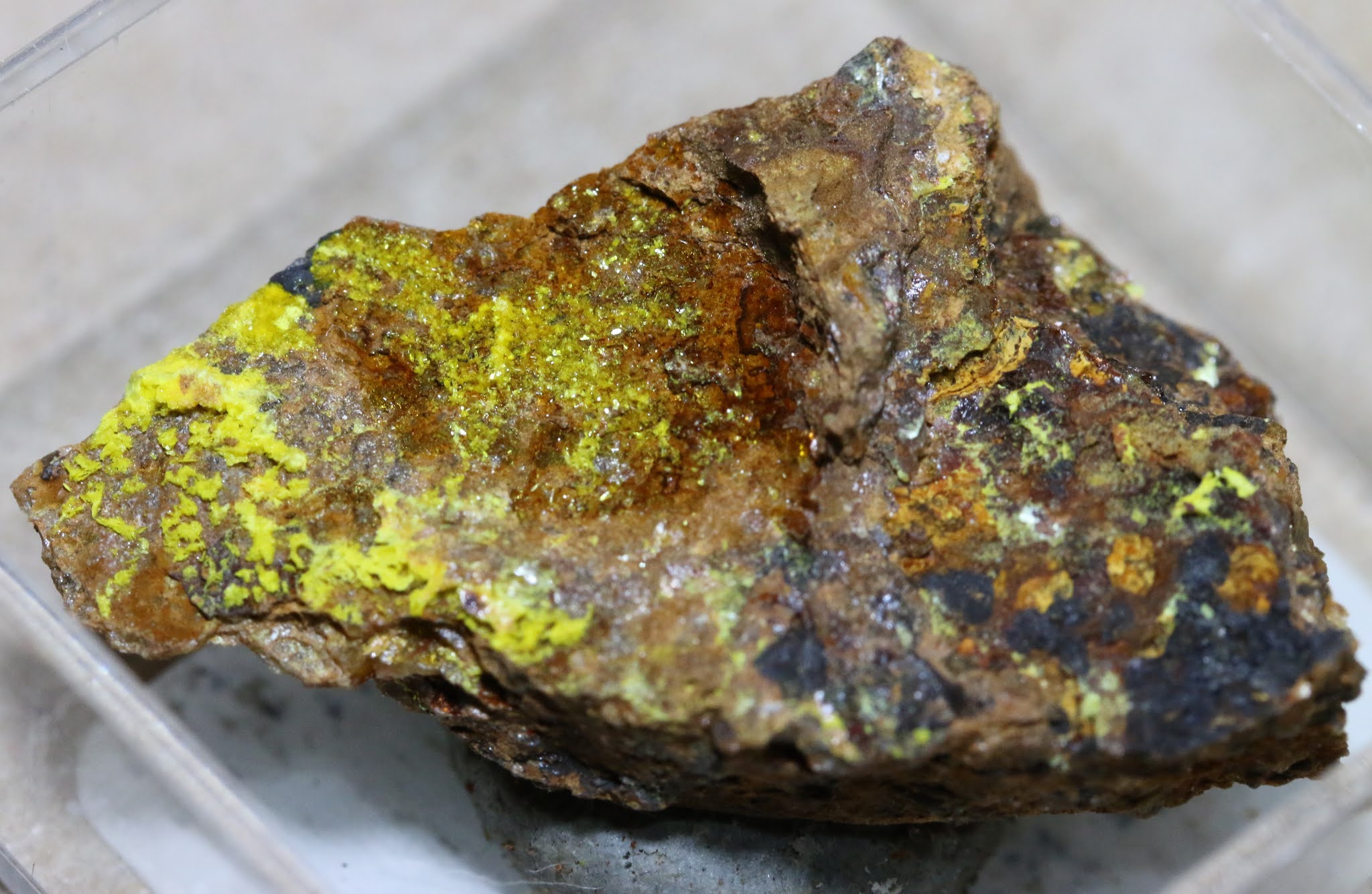
For a reference, this mineral from my collection - Meta-Zeunerite (Hydrated Copper-Uranium Arsenate - Cu(UO₂)₂(AsO₄)₂•H₂O) is a secondary Uranium mineral with natural radioactivity due to U-238, U-235 and a slew of daughter products.
This particular specimen is from the Clara Mine, Oberwolfach, Ortenaukreis, Freiburg Region, Baden-Württemberg, Germany. Activity is around 300 CPM.

Here is the Gamma-Spectrum of the Zeunerite sample- a classic natural Uranium spectrum with a number of daughter product peaks - Lead-214, Bismuth-214, Ra-226 etc.

Update:
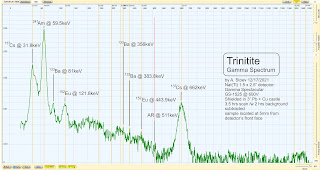
Michael Magiera of Trinitite Rocks asked me to do another Trinitite scan of a sample he provided and this time I didn't go for the typical 6-8 hrs. Sometimes small peaks are lost during long scan and especially if smoothing/flitering is used. I scanned the sample only 3.5 hours (/w 2 hours of background subtraction) and this scan revealed something that I have seen before in Trinitite samples but not really paying too much attention at it... 

This spectrum clearly reveals Ba-133 photopeaks! This begs the question - where this Barium is coming from? Initially it made no sense to see Ba-133 and I was ready to chalk it off as an environmental influence or something parasitic in the detector. Then I looked deeper into the design of the Gadget. 

The explosive lenses used to implode the Pu core of the "Gadget" were made out of fast and slow explosives in order to control the shockwave and achieve an equally distributed and uniform implosion force - this was the whole purpose of the "lens" assembly. The geometry and explosive compounds used for different parts act as shape-charges creating multiple shockwaves with different velocities, canceling peaks and valleys in the shockwave until all eventually evens out at the surface of the core squeezing it uniformly from all sides.
 As it turns out, for the "slow" explosive components in the lenses, they used "Baratol" - a lower velocity explosive compound which is made of a mixture of TNT and Barium Nitrate (nearly 70% of the mixture). The Barium Nitrate contains natural, stable isotopes of Ba-130 and Ba-132 which, when exposed to the incredible neutron flux undergo neutron capture and are converted into the synthetic Ba-133 isotope seen in this spectrum.
It is pretty amazing to realize that as the bomb exploded, the intense neutron flux even converted the conventional explosives into radioactive nuclides and I can detect this at home, almost 80 years later (or nearly 8 half-lives of Ba-133 (10.55y)) in a piece of melted sand with the spectroscopy setup I built.