Finally found some time to work again on the Gamma Dog project.
I had 3 GD electronics modules from the Gen 3 run and a bunch of 38B57 detectors laying around so I decided to turn them into actual units and add some improvements to the firmware.
New Firmware release - Current version is 5.9. These are just some of the improvements:
- completely new sound library with harmonic suppression and advanced clicking capabilities during low frequency output. The overall sound quality is vastly improved, and the instrument now sound a lot more "musical" and pleasing to the ear. The sound library also includes a slight "vibrato" effect during a lengthy continuous tone to break the monotony . I retained the standard sound version as an option in case someone is missing the harsher, 80s computer-like sounds. (menu selectable). This is one the most significant improvements in this version.
- "clicker mode" option (part of the new Advanced Sound Library) for very low rates where the audio frequency is just way too low for pleasant listening. When the audible frequency is below a certain threshold - for example 250 Hz / 250 CPS (this adjustable upper threshold is from 100Hz to 250Hz in 50Hz steps, via a Menu Item), in this mode the audio will automatically switch to Geiger Counter-like "clicks" instead of the very low frequency tone "growl" and it will go back to tone (with some hysteresis) once the rate is increased above the threshold frequency. There is a normal and fast clicker modes (menu selectable)
- new "Peak Meter" display mode displaying current rate vs. squelch level with an adjustable "Peak Hold' feature and dynamic range adjustments / auto-scale. Faster response time than the normal rate display mode - on-screen response is 0.5 sec. This mode is designed the to give the user better visual feedback of the activity maximums and how rate fluctuates referenced to the set Squelch level.
- completely re-written and improved menu system that is now bi-directional and with much faster UI response - scrolling through the list of menu items and the ability to go quickly up and down the list makes for a better user experience. Code now internally allows me to easily add new menu items and re-organize the menu list (24 menu items as of this version). Navigation is the same with the addition of UP-button long-press that scrolls up in the menu list.
- major internal restructure and optimization in the audio-generation routine making it a lot more efficient.
- improved / fixed exit behavior of the "Open Squelch" Menu / Selector for Softkey / Volume selections displaying the current settings without advancing when toggled between Volume and Softkey choices. In Open Squelch mode now a button click will switch modes - UP- Frequency Multiplier and DOWN- Volume and any consecutive clicks of the same button will scroll through the available options.
- countless improvements and optimizations throughout the code and many small bug fixes and refinements. The display library was rewritten for faster transfer of the screen memory buffer to the display unit. Ability for restart without cycling the power. On the UI side, the green led flashes every time squelch is set - either automatically or manually.
My dear friend Charles Young designed and 3D Printed enclosures for his line of Gamma Dogs. To make these usable with my existing GD electronics packages, all I needed is to whip out an STL and 3D print an "Adapter Coupling" between my standard ABS Endcap and his 3D Printed detector housing. The coupling also tapers down to the smaller diameter housing without creating a "lip".
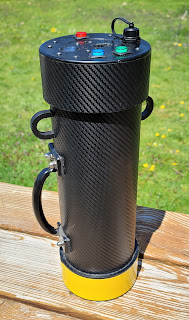
This is how the "Mini" looks with the housing for Bicron 1.5" x 2.25" NaI(Tl) or Scionix-Holland 38B57 detector.
"Gamma Dog Mini" joins the ranks.
This version is intended for localization of specimens discovered by the "Big Dogs" or it can be used as the main instrument as well. Due to the lower weight and smaller size of the detector it is really easy to manipulate inside a hole during digging.
The 38B57 detector (modified, 120 MOhm divider) is quite versatile and effective while lightweight.
No changes on the UI panel other than the addition of a Power button guard that protects the button from accidental activation/deactivation during use and transportation
New "Peak Meter" display mode.
Bar shows the current rate, evaluated and drawn on screen every half second with Min/Max Rate display.
The thin, long vertical line shows current Squelch level and moves dynamically based on rate range and current squelch level.
The short, thick vertical bar is the "Peak Hold" feature marking maximum level during past 1, 2 or 3 seconds (adjustable).
The decay time of "Peak Hold" is adjustable via the menu system - 1 sec., 2 sec and 3 sec.
The "Auto-Scale Range" continuously re-evaluates and adjusts the location of the bars regardless of the current rate range. The screen span is always adjusted to represent Min/Current and Maximum Rate and relation to the Squelch Level.
This Display mode is in rotation with the other two modes (Rate and Time/Rate Histogram) by pressing and holding the display button.
Some other improvements:
- Scroll direction of the Rate-vs-Time histogram is User-Selectable now via the Menu System
- The instrument will automatically do Squelch Auto-Set a few seconds after wakeup from sleep, based on the selected Squelch Method. ("Ruggles Mine" edition - feature developed on-site, added and tested during our trip to Ruggles Mine). This function makes sure that Squelch is always current when GD wakes up from Sleep and it is essential if Sleep & Charge mode is deployed and units is transported while charging.
- Old Auto, Logarithmic and Exponential Audio Response Modifier modes were replaced with 3 completely new, and more sophisticated modes Auto, Auto - FD (Fast Decay), Low Activity Optimized Mode and High Activity Optimized Mode.
Low Activity mode is optimized specifically for extremely low Activity detection where small CPS changes are scaled up and mapped with broader Audio Frequency Response
High Activity as the name implies extends the Count Rate to Frequency mapping over a broad range of rates to handle conversion for extremely active specimens preventing the tone from getting too high.
Auto Mode dynamically scales the frequency range to the currently detected maximum rate using a Leaky Peak Detection to determine the ceiling of the of the frequency range. The optimal audio response is then mapped to the established range (evaluated every second)
Auto Mode - FD (Fast Decay) is a more agile version of the normal "Auto" mode with twice as fast leak rate for the peak detector and when compared to Auto, it adapts faster to changes in the environment at the expense of more frequent tone pitch scaling.
- Battery charging status and voltage sampling is done every 30 seconds now (it was every 1 minute)
- Green LED flashes every time Manual or Automatic Squelch Set is performed as a visual indicator
- Startup Health-Check is optimized and improved with more accurate measurement algorithm.
- Optimized battery capacity evaluation
- dozens of minor improvements, UI changes, cosmetics and bug fixes.




No comments:
Post a Comment